A Portrait of Friendship, Rift, and Renewal
On this day 200 years ago, two great men passed into history. Their friendship, though at times strained, eventually ended in a warm, respectful relationship that ended on this day 200 years ago.
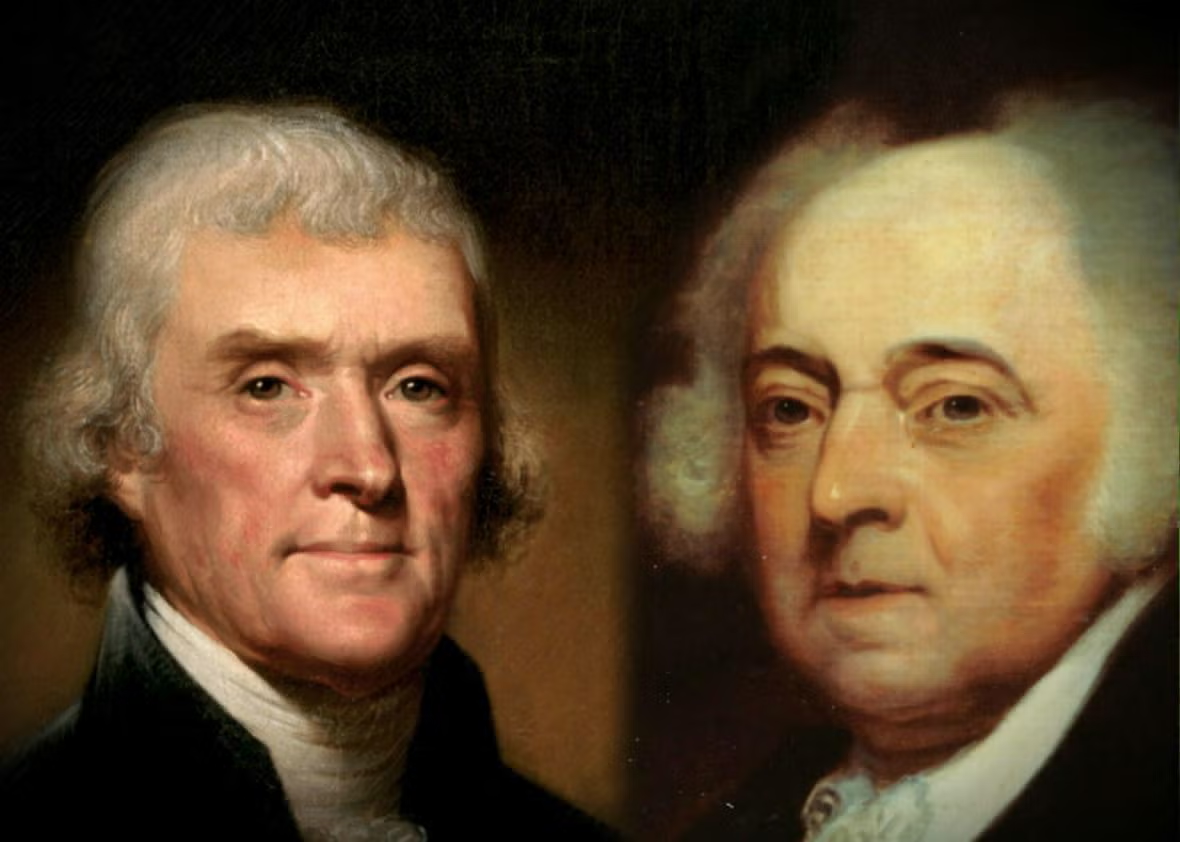
John Adams and Thomas Jefferson first met as delegates to the Continental Congress in 1775—an unlikely pairing that quickly proved essential. Adams, the fiery Massachusetts lawyer, and Jefferson, the reserved Virginia planter with a genius for prose, bonded over a shared devotion to American independence. On the Declaration of Independence committee in 1776, Adams pressed Jefferson to draft the document—“a Virginian, and a better writer than I am”—then defended it with tireless force. Jefferson called Adams “our Colossus on the floor,” capturing the partnership’s balance: Jefferson’s architecture of principle, Adams’s mortar of argument.

Their alliance deepened in the 1780s while serving as diplomats in Europe. In salons and studies they tested republican ideals against the realities of power, trade, and diplomacy. Jefferson became a fixture in the Adams household and formed a notable intellectual friendship with Abigail Adams, underscoring mutual trust. If the Declaration imagined a republic, their friendship modeled the civic habits—candor, respect, argument without contempt—needed to sustain one.
The 1790s fractured that harmony as the new nation defined its course. Adams emerged as a leader of the Federalists—favoring a strong national government, fiscal consolidation, and caution toward revolutionary France. Jefferson led the Democratic-Republicans, championing agrarian liberty, decentralized power, and more sympathy for republican movements abroad. These were not merely policy differences; they reflected divergent readings of human nature. Adams feared faction and the volatility of passion; Jefferson feared the encroachments of centralized authority.
The rupture peaked in the bruising election of 1800. Slanderous newspapers and hardened party loyalties turned former comrades into symbols of opposing visions. Jefferson won; a wounded Adams left Washington before the inauguration. More than a decade of silence followed—private pain with public causes—suggesting that the partners of revolution had become prisoners of its politics.

Reconciliation arrived in 1812, nudged by Dr. Benjamin Rush. Adams sent a brief New Year’s greeting; Jefferson answered warmly. Thus began a remarkable correspondence—over a hundred letters across fourteen years—in which they revisited the Revolution, philosophy, religion, science, and the young republic’s prospects. Their differences endured but mellowed into inquiry rather than recrimination. Jefferson remained the poet of possibility, trusting reason and education; Adams the diagnostician of ambition, warning against the distortions of power. Each corrected the other’s excesses. Their exchange became a public tutorial in disagreeing without dehumanizing—principled, informed, and bounded by regard.
Their renewed friendship took on symbolic weight. If their rift had mirrored the republic’s turbulence, their reconciliation suggested its capacity for self-correction. As living bridges to the founding, they narrated triumphs and failures without illusion, reminding posterity that ideals must be tested against experience and revised without surrender. The arc of their relationship offers a syllabus for citizenship: principle needs both poetry and prose; fierce disagreement need not harden into permanent enmity; reconciliation is work, sustained by humility and time.
On July 4, 1826—the Declaration’s fiftieth anniversary—both men died, Jefferson in Virginia earlier in the day, Adams in Massachusetts later. Adams’s reported final words, “Thomas Jefferson survives,” were factually mistaken but poetically apt: each survived in the other, and together they survive in the nation they helped to found. Their story resists easy partisanship. It is a human account—brilliant, flawed, generous, sometimes unjust—of two minds wrestling toward a durable republic. If the Declaration announced a people’s claim to liberty, the correspondence of Jefferson and Adams shows how a free people might learn, across differences, to keep it.
#America250
#thomasjefferson
#JohnAdams
#declarationofindependence