2026 marks the 200th anniversary of the United States Navy’s Musician (MU) rating, celebrating two centuries of musical heritage and service. Although the Bugler rating had a much shorter history, it played an important role in shipboard life before electronic sound systems, when bugle calls communicated daily routines, ceremonies, and commands throughout a vessel.
WHAT IS A NAVY RATING?
This article is from my Substack, which is reader-supported. To receive new posts and support my work, consider becoming a free or paid subscriber.
If you have ever tried to address a sailor by rank at a joint command, you may have learned that the Navy describes enlisted personnel using pay grade, rate, and rating. Pay grade is the familiar DoD structure – E-1 through E-9 for enlisted personnel, W-1 through W-5 for warrant officers, and O-1 through O-10 for commissioned officers. Rate is an enlisted sailor’s position in the pay structure and chain of command, roughly equivalent to rank in other branches. For example, an E-5 holds the rate of petty officer second class. In traditional Navy terminology, officers have rank, while enlisted sailors have rate.
Rating is the sailor’s occupational specialty, such as boatswain’s mate, hospital corpsman, electronics technician, or intelligence specialist, or in the case of this article a bugler. The Navy commonly combines rating and rate into one designation: an E-4 musician first class is abbreviated MU3, E-5 is MU2, and E-6 is MU1

THE NAVY BUGLER RATING
When military buglers are discussed, attention often centers on Army bugle calls in garrison or mounted buglers sounding commands in battle. Buglers also had a long and distinct place in the United States Navy. By the twentieth century, Navy bugle calls regulated routine activities, summoned personnel, rendered honors, and communicated emergency orders aboard ships and at shore installations.
The Navy’s Manual for Buglers described more than 100 calls. Among them were familiar calls such as “Reveille,” “Mess Call,” “Morning Colors,” “Evening Colors,” and “Taps.” Others served specifically naval purposes, including calls to summon boats, signalmen, working parties, and range-finder crews. Emergency calls included “Man Overboard” and “Abandon Ship.” The manual explained that, despite modern communications equipment, the bugle remained a traditional means of rendering honors, attracting attention for announcements, and signaling the routine of the day. Manual for Buglers, U.S. Navy

Buglers also performed ceremonial duties. “Morning Colors” accompanied the raising of the flag at 0800 aboard ship and at naval stations. “Attention” could be sounded during passing honors, while the “Flag Officer’s March” followed the prescribed flourishes for officers of flag rank. At military funerals ashore, the bugler accompanied the firing party and sounded “Taps” at the committal service.
Manual for Buglers, U.S. Navy
The Navy formally established Bugler as an enlisted rating in 1871. In 1920, the existing rating became Bugler Second Class, and a first-class pay grade was established. The Buglemaster rating was established in 1927. A 1943 Bureau of Naval Personnel publication described a Bugler’s duty simply as sounding the necessary calls, while a Buglemaster trained buglers, served as a drum major, and instructed bugle corps. The same publication listed chief, first-class, and second-class Buglemaster grades, as well as Bugler First Class and Bugler Second Class, confirming that these ratings remained active during World War II.
Compilation of Enlisted Ratings

The Navy reorganized these ratings in 1948. Bugler First Class was incorporated into Seaman, and Bugler Second Class was incorporated into Seaman Apprentice. Buglemaster was incorporated into Quartermaster. The Navy’s official rating history lists 1947 as the administrative endpoint of the separate Bugler and Buglemaster ratings. Compilation of Enlisted Ratings

Although separate bugler ratings disappeared, bugling did not vanish from naval practice. Bugle calls continued to carry ceremonial meaning even as electronic announcing systems increasingly assumed their routine communications functions. Manual for Buglers, U.S. Navy
CHRONOLOGY OF THE BUGLER RATING
1871 The Navy established the Bugler rating.
1920 Bugler became Bugler Second Class, and a first-class pay grade was established.
1927 The Buglemaster rating was established.
1943 A Navy personnel publication listed Bugler and Buglemaster grades and described their duties.
1948 Bugler First Class was incorporated into Seaman; Bugler Second Class into Seaman Apprentice; and Buglemaster into Quartermaster.
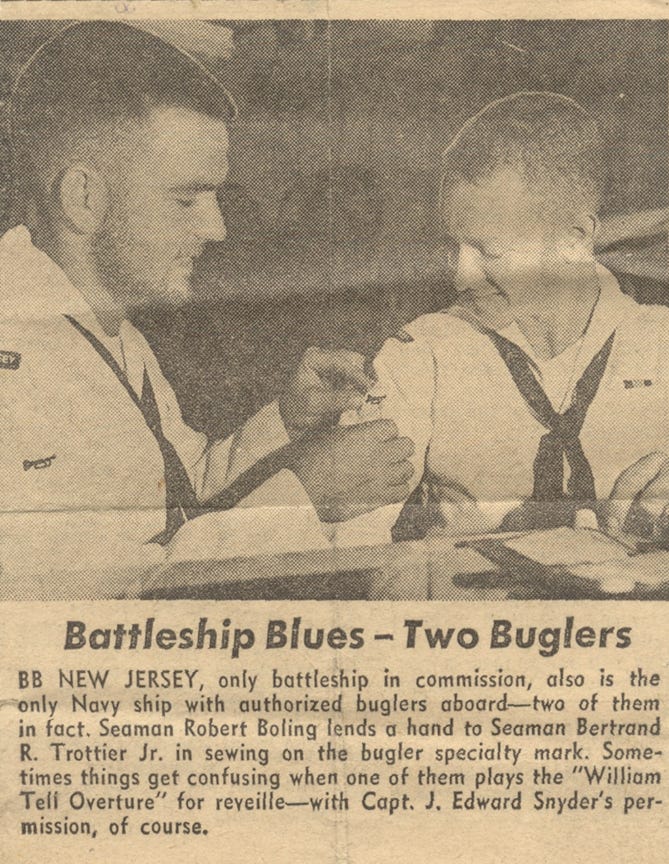
Although the Bugler Rating was discontinued, Bertrand R. Trottier, Jr. served as the Navy’s only bugler on the world’s only active battleship during its tour of Vietnam, from May 1968 to its decommission in December 1969. In 1968, at the request of battleship New Jersey Capt. J. Edward Snyder, who wanted real buglers on board, Trottier was hand-picked for the bugler position, the first Navy bugler in 21 years.

Trottier, who reported directly to the captain, averaged about 30 bugle calls a day, including reveille, chow call, general quarters, man your stations, liberty, evening colors and Taps.
The bugling tradition is carried on in US Navy Bands worldwide by musicians who hold the musician rating.

Bibliographic references
Charles A. Malin, Compilation of Enlisted Ratings and Apprenticeships, U.S. Navy, 1775 to 1969, revised December 1969. Bureau of Naval Personnel, Permanent Board for Review of the Enlisted Rating Structure. Naval History and Heritage Command
United States Navy, Manual for Buglers, U.S. Navy, Navy Training Courses. Naval History and Heritage Command
United States Navy, Bureau of Naval Personnel, Summary of Ranks and Rates of the U.S. Navy Together with Designations and Insignia, NAVPERS 15004, May 1943. NAVPERS 15004
https://www.sbsun.com/2014/05/20/last-navy-bugler-recalls-days-at-sea/
Jari Villanueva is preparing a history of buglers in the US Navy
Stay tuned…
This article is from my Substack, which is reader-supported. To receive new posts and support my work, consider becoming a free or paid subscriber.