
Charlie Hughes: The Baxter Bugler
By Jari Villanueva © 2026 TapsBugler

At the National WWI Memorial in Washington, DC, Taps is sounded every evening at 5 pm. This has been going on continuously since May 2021.

In Gettysburg, Taps is sounded each evening in the National Cemetery between Memorial Day and Labor Day. This tradition started in 2016.

At the Menin Gate in Ypers, Belgium, the Last Post has been sounded each evening since 1928
There are other places around the world where a bugle call is sounded on a continuous or regular basis, but I wondered if there was a place where one person sounded a call for any extended period of time.
I decided to check whether anyone held a record for playing the bugle for a long period of time. I discovered Charlie Hughes of Baxter, Tennessee. Hughes lived from 1888 to 1970 in his hometown of Baxter.

Here is his story:
The Baxter Bugler: A Legend at Daybreak
History books are full of generals, presidents, and inventors—but Baxter, Tennessee, produced a different kind of hero. His name was Charlie Hughes, born in 1888, a man who would someday wake an entire town simply because he thought it would be good exercise.
In 1922, Charlie purchased a $2.98 bugle from the Sears and Roebuck catalog—a purchase that probably fell somewhere between “galvanized wash tubs” and “underwear by the dozen.” He had no musical training whatsoever, but that didn’t slow him down. He blew into that horn until something resembling a note came out, and once he accomplished that, he began to think bigger. Much bigger.
At sunrise on March 15, 1924, Charlie climbed a pole he had built in his own yard—because nothing says dedication quite like scaling lumber before coffee—and blasted Reveille over the sleepy town of Baxter. And then he did it again the next day. And the next. And every morning for 36 straight years.
Residents didn’t need alarm clocks. They had Charlie.

Word of this high‑altitude bugling experiment eventually drifted beyond Tennessee’s borders. A national radio show in New York City caught wind of it and invited Charlie to perform live on air. So Baxter’s own bugler boarded a train to the big city and let loose his famous morning call for the entire nation to hear. The appearance turned him into a minor celebrity, complete with reporters, newsreel cameramen, and feature writers who journeyed to Baxter to witness the dawn serenade for themselves.
Charlie embraced the attention with sincere modesty and just the right touch of swagger. “There are lots of buglers,” he declared, “but none as famous as I. That’s because I climb a pole to do my bugling.” And he wasn’t wrong. Bugling from ground level suddenly seemed boring.
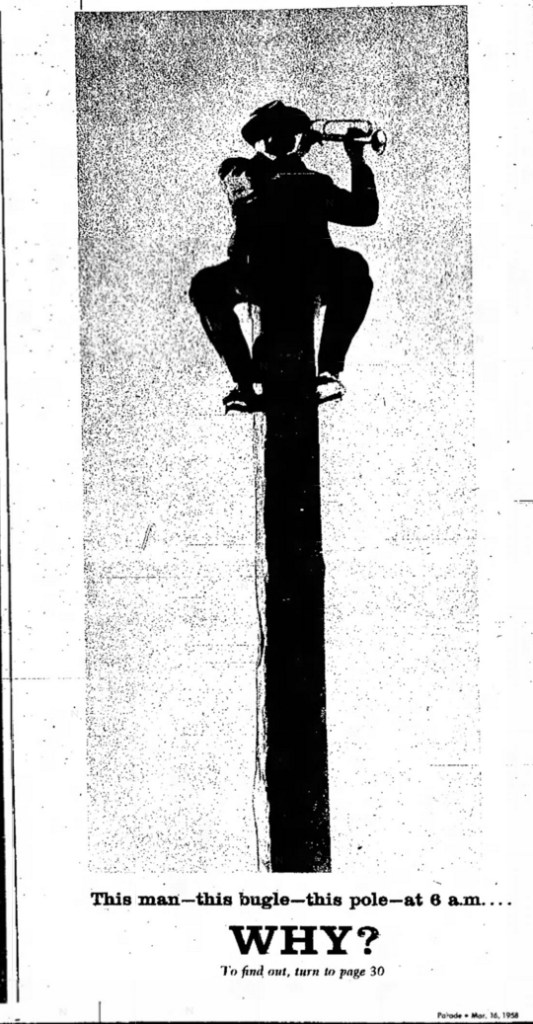


Despite the weather, he was up early around 4:30 to play except for the times he was either on vacation or traveling because of his fame. Some locals claimed that Hughes had money buried by his pole that he checked on each morning before climbing up to sound the morning call.

By 1938, the tradition was so entrenched that the entire town, led by Mayor Will T. Sewell, threw Charlie a 15th‑anniversary celebration. And not a soul complained. Even as Baxter doubled in size, no one ever threw a shoe, shouted a curse, or filed a noise complaint. Telephone operator Minnie Phillips put it simply: “It’s been going on so long that I think we’d miss it if Charlie stopped.”

What is interesting is that, as the town grew in population (up to 838 in 1958), no one objected to the sounds he made so early in morning. Hughes even reported that he never had anything thrown at him. Telephone operator Minnie Phillips said, “It’s been going on so long that I think we’d miss it if Charlie stopped.”

Hughes worked as a post-office messenger. He never married, first living with his mother and then with his sister, Ava, when he retired at age 65. A concession he made to retirement was moving his wake-up to 6 am and adding a bell he would also clang if he couldn’t blow the horn. Despite his bachelorhood, he said he was still looking. A woman from Virginia had proposed marriage if he would come to her farm and blow the bugle for her. He said he was too busy to take her up on it.

He continued faithfully until age forced his hand. By 1961, having lost too many teeth to play the right notes, he reluctantly retired the bugle. It was the end of an era. Charlie passed away in 1970, having lived 82 years—and more impressively, 36 of them climbing a pole at dawn to blast a military wake‑up call at unsuspecting civilians.

Charlie Baxter passed away on August 12, 1970 of heart failure.
For a man with a $2.98 bugle, a homemade pole, and a heart full of goodwill, Charlie Hughes carved out a legacy that still echoes, faintly, through the hills of Tennessee. Heroes come in many forms. Baxter’s just happened to come with a bugle and a remarkable morning routine.
So that is some record. Let’s see if someone can top that!
There are several Charlie Hughes stories from multiple news papers reproduced in the following page. There are also stories on the 1920’s and 1930’s pages.
http://www.baxterseminary.org/BSNews_Historical.html?fbclid=IwAR0092eEHRBomAy3A9oWgOETieo7UE_jZp31qktfM2Y4BHm7qakJXgsc8EI









Be First to Comment